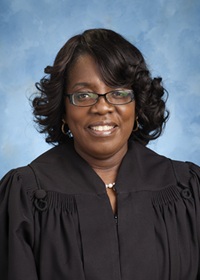
There are many reasons Judge Shiela Turner McCall decided to practice law, but accountability was the biggest. Fresh out of college, she took a temporary job at a women’s shelter to make ends meet. It was supposed to be temporary until she followed her career path into sales. Instead, Judge Turner McCall began to feel a strong sense of responsibility to the women she served. Their stories and bravery at a time when everything seemed so dark made her want to help seek justice for people escaping domestic violence.
While working at the shelter, the final bit of inspiration that changed Judge Turner McCall’s calling came from Jodie Foster’s portrayal of a rape survivor in the award-winning movie “The Accused.” The movie, based on a true story, ignited something in her, and she decided to become a social worker. She loved the work she was doing as a social worker. It was important and vital, but she still felt a different call to justice. A former professor had expressed the belief that the passion behind her writing in his class would make her a good attorney. With experience as a social worker and a desire to pursue justice, she entered law school.
With her law degree, she became a victim’s advocate and, eventually, a prosecutor, then a judge. Her passion has always been finding justice for victims of crime. Along the way, she has also learned the most effective ways to advocate for survivors in the judicial system. Despite decades of experience, she always goes back to what her first mentor at the shelter said.
“It might be the 15th time you've done it; it's that person's first time. Keep that in mind when you're dealing with people,” Judge Turner McCall said.
Despite the prevalence of domestic violence cases on her docket, she makes sure to look at each case with fresh eyes. She wants each person to know their story matters.
“By the first time violence happens, it's a shock to most of the women, because they never saw that side of that person. And, of course, it gets excused because he or she says, ‘Oh, I didn't mean it, baby,’” Judge Turner McCall said. “Before you know it, now you're invested emotionally and sometimes financially, and certainly with kids, and to just walk away, it's not something most of us could do.”
Despite it being the hardest thing many people have ever had to do, Judge Turner McCall emphasizes how crucial it is to try to remove yourself from a domestic violence situation. She has seen people get back on their feet and live successful lives without an abusive partner, but she also has cases that will stay with her for the rest of her life.
“I was doing a seminar on domestic violence with the mother of a victim who'd been murdered by a domestic violence offender,” she remembers. “She said he would always be really violent with her and then come to the hospital and bring her flowers and tell her he's sorry.”
“This particular day, he was super violent. He stabbed her repeatedly. And unbeknownst to him, she died. And he showed up at the hospital with the flowers. Because, of course, in the past, it was always something he could fix. So when he found out that she was dead, he lost it. That filter of understanding that your behavior has consequences is something that I think judges have to take responsibility for doing and making sure that we're holding him responsible as we keep the community safe,” Judge Turner McCall said.
This is why Judge Turner McCall emphasizes the importance of reaching out for resources and help as soon as possible.
“Domestic violence is about power and control. It's not about hitting,” Turner McCall said.
That’s why she says it’s difficult and painful for many people looking to leave a violent situation. She says while it’s never easy, the earlier people are able to step away, the more options become available.
“I would say the minute they put their hand on you the first time. And I know it's hard to do, because, in most cases, you’ve fallen in love with this person,” Judge Turner McCall said.
Making a report or filing for a restraining order doesn’t mean you have to testify in court, but she says hearing a victim’s statement can be incredibly powerful for a judge when deciding how to handle a case. She also says that even if a survivor doesn’t want to get involved in a case initially, they can get involved, access resources and speak at any point.
“Most victims think that because they didn't come in arraignment, they can't come later. You can get a protection order at any point during the hearing. It's very important for people to understand that. It's very impactful to have the victim come so that they know that somebody cares about what happened to them,” Judge Turner McCall said.
When survivors decide to be involved with their case, resources are made available through the Prosecutor’s Office and a victim advocate. This can help further connect people to additional resources, including local counseling options, shelters and more.
Judge Turner McCall also thinks it’s crucial for people to know that they don’t have to go down the criminal route to seek a protective order. They can also be obtained in civil court.
“Let's say I don't want to have criminal charges issue against a person, but I want to feel safe.
Then you can go to domestic relations court or come to common pleas court, and get a civil protection order,” Judge Turner McCall said.
A protection order is a big reason to involve the justice system when in a domestic violence situation. Through Judge Turner McCall’s time as a social worker, in the Prosecutor’s Office and as a domestic violence prevention advocate, she says this step can make a bigger difference than many realize, especially if the alleged abuser regularly comes by.
“I always tell victims when I'm giving protection orders in court. The 1st thing out of your mouth is I have a protection order. Say I have a protection order against that person, and that puts you at a high priority, and then the police come faster,” Judge Turner McCall said. “It's just a piece of paper unless you use it correctly.”
It bothers Judge Turner McCall how prevalent domestic violence is in our community. She says at least 10 percent of the cases she sees are related to a violent domestic incident. This is why she emphasizes the importance of teaching healthy relationships and healthy love from a young age.
“I say this in court a lot. You're teaching the boys that this is how you show love and you're teaching the women, this is what I expect from love,” Judge Turner McCall said. “It's important for us, as a community, to take it more seriously, so that we can stop this from happening, or at least limit it as much as we can. And the only way to do that is accountability.”